May 2026
May 2026
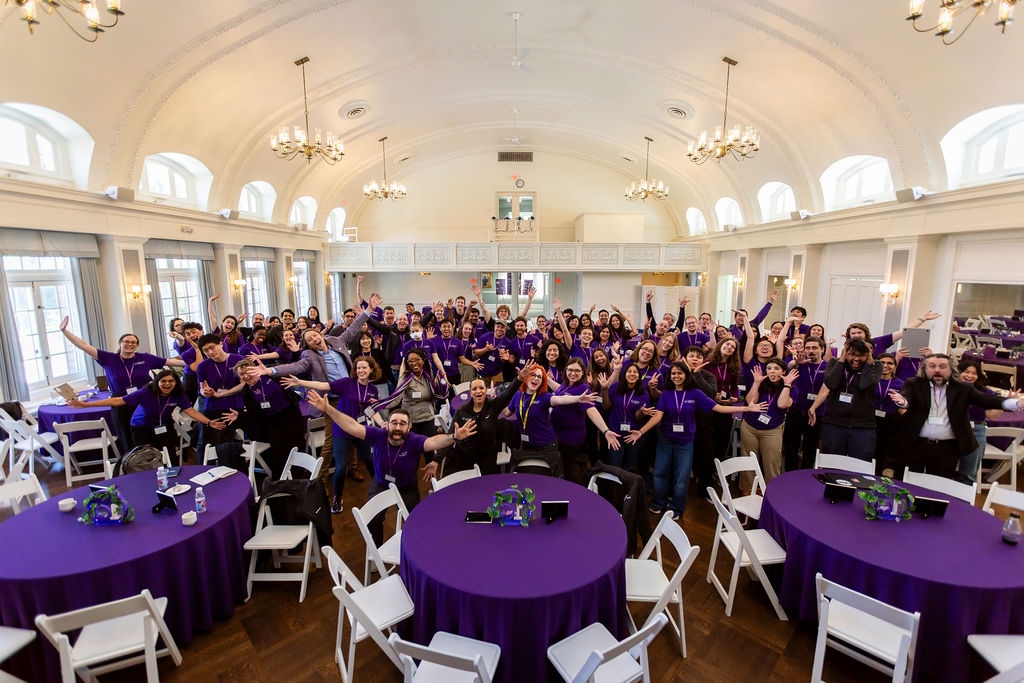
Center for Synthetic Biology marks a decade of research innovation
CSB recently celebrated its 10th anniversary, marking a decade of interdisciplinary research and real-world impact across medicine, sustainability, biomaterials, and biotechnology. Since its founding, the center has grown into a vibrant research hub spanning Northwestern Engineering, Weinberg, and Feinberg, supporting 24 faculty collaborators, 85+ joint publications, 300+ graduate students and postdocs, 100+ undergraduate researchers, and eight startup companies — backed by more than $53 million in research funding. The anniversary event brought together faculty, trainees, alumni, industry leaders, artists, and collaborators to reflect on progress and look ahead to the next wave of synthetic biology innovation.
In this issue:
Research Activities Across Campus
- Northwestern launches Living Electronics Initiative
- Researchers, journalists discuss how scholarship reaches the public
- ANTEC’s Scientific Illustration Service boosts research communication
Research Breakthroughs and News
- New AI tools reveal hidden bias patterns
- Rewiring psychiatry: researchers rethink mental health treatment
- Study explores link between personality traits and mortality risk
- Researchers develop framework for responsible AI in health implementation
- Study looks at how AI could influence teen identity
- Electric control of spin could power next-gen electronics
- Researchers examine impacts of immigration policy
- Faculty accolades highlight science, policy, and the arts
- New student scholarship campaign launches
Important Policy and Guidance Updates
Research Activities Across Campus
Northwestern launches Living Electronics Initiative
What if electronics could sense, adapt and even heal like living systems? A new Northwestern initiative is bringing together researchers across bioelectronics, synthetic biology, materials science, and medicine to advance “living electronics” — integrated systems that combine engineered biology with electronic technologies. Led by Jonathan Rivnay of the McCormick School of Engineering, the Living Electronics Initiative aims to accelerate collaboration and discovery in areas ranging from responsive therapeutics and environmental sensing to advanced manufacturing and biohybrid robotics.
Important Policy and Guidance Updates
NIH requires disclosure of foreign collaborations
NIH-funded investigators must disclose collaborations that qualify as a “foreign component” and obtain prior NIH approval, including collaborations with investigators at a foreign site that may lead to co-authorship, use of foreign facilities or instrumentation, or financial or in-kind support from a foreign entity—even if no NIH funds are spent on the foreign activity or the co-author's involvement.
NIH is paying closer attention to compliance, including reviewing publications in progress reports, so investigators should identify foreign components in proposals, request approval before work begins, and keep Other Support and Biosketch disclosures current.
If you’re unsure whether an activity qualifies, contact Sponsored Research (and Export Controls & International Compliance for high-risk countries). NIH Foreign Component Guidance
Research Activities Across Campus
Researchers, journalists discuss how scholarship reaches the public
At a recent Institute for Policy Research and Medill discussion, journalists and scholars explored how researchers can more effectively engage public audiences in an increasingly complex media landscape. Moderated by IPR Associate Director Laurel Harbridge-Yong, the panel featured Medill Dean Charles Whitaker, Louise Kiernan, and Natalie Moore, who encouraged faculty to proactively share their expertise through op-eds, media relationships, and other public-facing platforms. Read more.
Research Breakthroughs
New AI tools reveal hidden bias patterns
A new study from IPR researchers introduces machine learning methods that can identify subtle patterns in large datasets that traditional approaches may overlook. Led by graduate research assistant Jonathan Doriscar with faculty members Tessa Charlesworth and Sylvia Perry, the work demonstrates how these tools can uncover more nuanced profiles of racial attitudes and help researchers design more targeted interventions. Read more.
Research Activities Across Campus
ANTEC’s Scientific Illustration Service boosts research communication
An on-campus scientific illustration service — offered through CRN’s Analytical bioNanoTechnology Equipment Core — provides researchers with professionally crafted visuals that communicate complex concepts to bolster grant proposals, scientific presentations, and manuscript submissions. The service includes 2D and 3D illustrations, animations, journal figures, graphical abstracts, cutaway diagrams, technical drawings, and cover art. Learn more.
Research Breakthroughs
Rewiring psychiatry to rethink mental health treatment
Northwestern Medicine researchers are helping reshape the future of psychiatry through new approaches that combine neuroscience, engineering, AI, and personalized medicine to better understand and treat mental illness. Led by psychiatrist Sachin Patel and collaborators across Northwestern, the work aims to move beyond trial-and-error approaches by identifying the biological mechanisms underlying conditions such as depression, anxiety, and PTSD — to develop more targeted and effective therapies.
Research Breakthroughs
Study explores personality traits and mortality risk
A recent Northwestern co-authored study published in the Journal of Personality and Social Psychology examined how personality traits may influence long-term mortality risk across large longitudinal datasets. The researchers found that higher levels of neuroticism were associated with increased risk of premature death, while higher conscientiousness and extraversion were linked to longer survival. The findings suggest that personality may shape health outcomes through factors such as stress response, social connection, and health-related behaviors.
Research News
Researchers develop framework for responsible AI in health implementation
Rinad Beidas, a faculty affiliate of Northwestern’s Institute for Artificial Intelligence in Medicine (AIM), is helping lead the development of a new framework for applying artificial intelligence in implementation science, the field focused on translating research discoveries into real-world healthcare practice. Beidas is a co-author of a recent publication in Implementation Science that outlines how the AIM-IS initiative will create a framework, toolkit, and reporting standards to guide responsible AI use.
Research News
Study looks at how AI could influence teen identity
Northwestern researcher Elizabeth Gerber — a professor of mechanical engineering and communication studies and an affiliate of the Institute for Adolescent Mental Health and Well-Being — is exploring how generative AI may be shaping the way teenagers develop their identities and express themselves online. Her work suggests that many teens are turning to AI not just to get things done faster, but to help craft how they tell their stories and present themselves to others.
Research Breakthroughs
Electric control of spin could power next-gen electronics
A Northwestern-led research team headed by materials scientist James Rondinelli has demonstrated a new way to electrically control electron spin, a breakthrough that could help enable faster, more energy-efficient electronics. The work advances the field of spintronics, which seeks to use electron spin rather than electrical charge to process and store information, potentially reducing energy demands for future computing technologies.
Research Breakthroughs
Researchers examine impacts of immigration policy
A new study led by Institute for Policy Research sociologist Julia Behrman explores how researchers are increasingly using large datasets and new analytic tools to measure the effects of immigration policies across local, state, and federal levels. The work examines both intended and unintended consequences of policies on immigrant and non-immigrant communities, offering new insight into how immigration policies shape health, economic stability, and public wellbeing.
Research News
Faculty accolades highlight science, policy, and the arts
Northwestern faculty affiliated with the Institute for Policy Research and Weinberg College recently received honors recognizing influential work across the sciences, social sciences, and arts. Honorees include Sera Young, Charles Manski, Roel Tempelaar, Carole LaBonne, Matthew Goldrick, and others whose work spans water insecurity, decision-making under uncertainty, quantum-informed materials science, developmental biology, language production, democratic participation, experimental film, and policy-relevant social science research. Learn more here and here.
Research News
New student scholarship campaign launches
Northwestern has launched the Forever Shine Campaign, a University-wide effort to raise $625 million for scholarships and student support programs. The campaign aims to expand access and opportunity for undergraduate, graduate, and professional students, including support for first-generation and lower-income students through initiatives such as the Beacon Scholars program. Learn more.
Important Policy and Guidance Updates
Updated DoD Risk Decision Matrix
The Department of Defense released updated research security rules, effective March 9, 2026, that may affect eligibility for DoD funding and introduce new review or mitigation requirements. Under the revised DoD Risk Decision Matrix, proposals may be flagged for risk, require additional review, or be denied.
You may be impacted if you:
- Collaborate with or have published within the past five years with entities on expanded U.S. restricted or prohibited lists;
- Use foreign-sourced research equipment from prohibited organizations;
- Participate in foreign talent recruitment programs or receive foreign funding or patent support from a country of concern, including China, Iran, North Korea, or Russia.
What this means:
- Certain equipment and collaborations may be prohibited on new DoD-funded projects;
- Previously allowable relationships or resources may now require review or mitigation.
Researchers with current or planned DoD funding should review the updated Decision Matrix and guidance and assess risks early. The Export Controls & International Compliance team is available for questions, risk reviews, and mitigation support.
Research News
Annual Evanston Central Utility Plant shutdown, June 18–22
Northwestern’s Central Utility Plant shutdown on the Evanston campus will occur from 5 p.m. Thursday, June 18, to 10 p.m. Monday, June 22. During this time, heating, hot water, and air conditioning will be disrupted in buildings across Evanston; the Chicago campus is unaffected. The campus remains open, except for Juneteenth on June 19. Employees should check with supervisors about schedule changes. Research buildings will still receive cooling for labs and research spaces, with Facilities Management coordinating with the research community. Questions? Contact AVP Jim McKinney at james-mckinney@northwestern.edu.