February-March 2026

February-March 2026
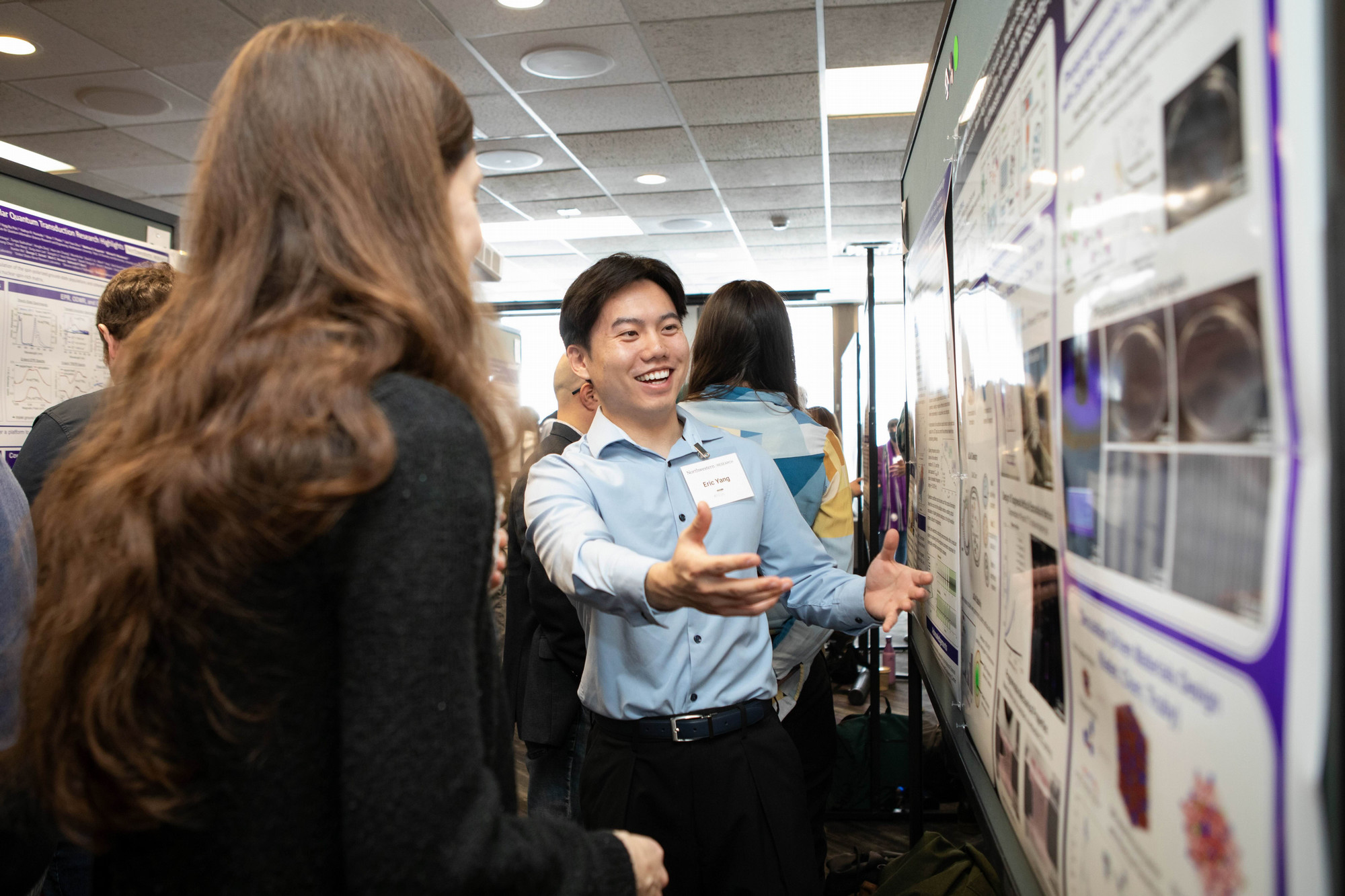
Built for Breakthroughs
Research Impact Day Showcases Cross-School Innovation in University Research Institutes and Centers
The inaugural URIC Research Impact Day underscored how the University Research Institutes and Centers (URICs)—Northwestern's flagship, University-level interdisciplinary research hubs—enable teams to pursue breakthroughs that no single field, school, or laboratory could achieve alone. Designed to bring together exceptional talent, shared infrastructure, and strong institutional incentives, URICs cultivate high-impact, collaborative discovery that most universities struggle to support at scale.
The event opened with a powerful example of this cross-campus ecosystem in action: the world's smallest, fully bioresorbable pacemaker for newborns, created through deep collaboration among engineers, materials scientists, and Feinberg clinicians.
Over 250 attendees learned how nearly two dozen URICs connect more than 700 faculty members across 75 departments, fueling innovations that enhance Northwestern’s research leadership. Presentations from URIC directors and affiliates—including John Rogers, Mark Hersam, Andrew Papachristos, Milan Mrksich, and Ted Sargent—illustrated how these institutes use shared facilities and team science to promote new discoveries in bioelectronics, physics, materials science, sustainability, nanotechnology, chemistry, and the social sciences. Full story.
Topics include:
- Powering and integrating emerging technologies
- Entrepreneurship and financing
- Geopolitics
- New frontiers like quantum pilots, space-based energy, agentic AI in energy systems
- More
Kickoff lunch: Jan 13, noon, Kellogg Global Hub (KGH 5301). Future dates: Feb 17, Mar 10, Apr 7, May 5.
Sign up to attend or join the mailing list.
Save the date: April 17, 2026—Energy Innovation and Emerging Technologies Conference, co-sponsored by the Institute for Policy Research, Paula M. Trienens Institute, Roberta Buffett Institute, and the Center for Engineering Sustainability and Resilience.
Recent developments:
- Research Activities Across Campus
- Research Activities Across Campus
- Important Policy Changes
RESEARCH ACTIVITIES ACROSS CAMPUS
Ryan Fund Hits $8M, Powering Breakthrough Life Science Research
Northwestern has awarded more than $2 million to eight projects through the Pat and Shirley Ryan Family Research Acceleration Fund's latest round, supporting bold, early-stage ideas with strong translational potential. Now in its fourth round, the fund helps researchers bridge the gap between discovery and commercialization. The recent competition drew 41 proposals, including innovations in medical imaging, brain health, and autoimmune therapies. With awards of $200,000–$300,000 each, the fund is enabling teams to advance high-risk, high-reward work poised for real-world impact. Learn more.
RESEARCH BREAKTHROUGHS
New coating strategy unlocks air-sensitive magnets for quantum tech
A promising method for connecting quantum devices on a chip is to use magnons, magnetic waves that move through materials and carry information. Now, Northwestern materials scientist Mark Hersam and postdoctoral researcher Iqbal Utama have developed an ultrathin alumina coating that stabilizes the air-sensitive magnetic material vanadium tetracyanoethylene, enabling its use in quantum circuits and advanced measurements. Their low-temperature process preserves the material's magnetic properties and allows close-range study, marking a critical step toward scalable quantum devices that use magnetic waves, known as magnons, for next-generation information processing. This breakthrough allows researchers to explore the material's natural behavior in much greater detail than before and makes it compatible with superconducting circuits, paving the way for scalable quantum technologies. The research was published in Science Advances.
RESEARCH BREAKTHROUGHS
New nanomedicine from Mirkin lab wipes out leukemia in animal study
In a new study led by Chad Mirkin (chemistry, medicine, materials science), the team designed a new drug from a spherical nucleic acid (SNA), a nanostructure that weaves the drug directly into DNA strands coating tiny spheres. This design converts a poorly soluble, weakly performing drug into a powerful, targeted cancer killer that leaves healthy cells unharmed. Compared to the standard chemotherapy drug, the SNA-based drug entered leukemia cells 12.5 times more efficiently, killed them up to 20,000 times more effectively, and reduced cancer progression 59-fold — all without detectable side effects. Learn more about this promising advance. Also: Julianna Bourgeois, NU PhD candidate and Nanomedicine Subgroup Leader in the Mirkin Lab, explores how structural nanomedicine is transforming drug design for cancer and infectious diseases. Watch her 2025 Kabiller Award Dinner talk, "Blueprints for Better Drugs," hosted by the International Institute for Nanotechnology.
RESEARCH BREAKTHROUGHS
AI breakthrough enables 'shape-shifting' proteins
A Northwestern collaboration A Northwestern collaboration with Harvard's Paulson School of Engineering has achieved a breakthrough in the design of intrinsically disordered proteins (IDPs)—flexible biomolecules that make up about 30 percent of the human proteome and are central to many biological processes and diseases. Led by Northwestern's Krishna Shrinivas (chemical and biological engineering), the team developed a new machine learning framework that tailors IDP properties, offering powerful new tools for therapeutic design and fundamental insights into disease mechanisms. Shrinivas is an affiliate of NU's interdisciplinary Center for Synthetic Biology. The work appeared in Nature Computational Science.
RESEARCH ACTIVITIES ACROSS CAMPUS
Three Feinberg PhD Graduates Named Chicago Biomedical Consortium Entrepreneurial Fellows
The Chicago Biomedical Consortium has selected three recent Northwestern Feinberg PhD graduates as Entrepreneurial Fellows, a program that builds expertise in biotech development and translational strategy. Since 2006, CBC has fostered collaboration among Chicagoland institutions to accelerate discoveries into patient impact. Through its Fellows program, CBC is developing the workforce to execute early-stage biopharma programs. The program provides training in biotech development, project management, and translational strategy, building a local pipeline of skilled operators who can grow ventures as they scale. Notably, nine of 23 CBC Entrepreneurial Fellows have earned their PhDs at Northwestern.
This year's cohort includes:
- Taylor Brown, PhD, a regenerative engineer exploring vascular therapies and commercialization pathways.
- William Corcoran, PhD, a biological engineer specializing in synthetic biology, protein engineering, and cell therapies, with experience evaluating early-stage therapeutics ventures.
- Cristina Vaca, PhD, a microbiologist focused on developing functional cure strategies for HIV.
RESEARCH ACTIVITIES ACROSS CAMPUS
Investing in climate solutions and communities
Former White House Climate Advisor Ali Zaidi delivered Northwestern's Distinguished Public Policy Lecture, co-hosted by the Institute for Policy Research (IPR) and the Paula M. Trienens Institute for Sustainability and Energy, both University-wide research institutes. At the recent event, he urged the campus community to transform climate challenges into opportunities, noting rising economic and human costs while emphasizing the potential for innovation, policy, and collaboration to build resilient, equitable communities. "The solutions are within reach," Zaidi said. "We can get after them if we do it together." Find the full story.
RESEARCH ACTIVITIES ACROSS CAMPUS
NU astro-AI conference attracts thought leaders
From Sept. 2-5, the NSF-Simons Foundation-funded National AI Institute for the Sky (SkAI) hosted its inaugural annual conference, Open SkAI 2025, drawing over 180 researchers from 51 institutions. Held on the 35th floor of 875 N. Michigan Ave. (John Hancock Tower), the event featured keynote lectures, invited talks, and posters on cutting-edge astro-AI research. Founded in 2024 and led by Northwestern with core partners UChicago and UIUC, SkAI is directed by Vicky Kalogera (physics and astronomy), with Aggelos Katsaggelos (electrical and computer engineering) as co-PI. SkAI also hosted the first-ever POSYDON School in Chicago, where international astronomers gathered for intensive training on POSYDON, a groundbreaking software for modeling binary star systems developed by Kalogera, Katsaggelos and collaborators.
RESEARCH ACTIVITIES ACROSS CAMPUS
Students as Tech Ambassadors: Bridging generations, supporting stroke survivors
Supported by NIH and NUCATS, the ACROSS project—co-led by Northwestern's Lesli Skolarus and community principal investigator Tonya Roberson—connects stroke survivors with practical recovery resources. Partnering with Student Karma and Chicago Public Schools, the team empowered students to design digital tools and materials that help families navigate stroke care, bridging generations and making community health resources more accessible. The project develops simple, personalized interventions to optimize stroke outcomes within the context of people's everyday life.
IMPORTANT POLICY CHANGES
Sponsored Research moves aim for increased efficiency
As part of ongoing efforts to strengthen operations, Sponsored Research will implement an internal restructuring that will specifically impact the Proposal and Award Acceptance and Contracts and Negotiations teams. The primary goal of this change is to improve turnaround times, clarify roles, strengthen partnerships with the research community, and streamline processes. Teams will be reorganized into a Pre-Award team, a Contracts and Award Acceptance team, and an Award Management team. This change will take effect on November 18. Learn more.
IMPORTANT POLICY CHANGES
NIH Issues new biospecimen security policy
Effective October 24, the National Institutes of Health (NIH) has implemented a new biospecimen security policy (NOT-OD-25-160) aligned with Executive Order 14117 and 28 CFR Part 202. The policy restricts the sharing or distribution of NIH-supported human biospecimens to entities in countries of concern—China (Hong Kong and Macau), Cuba, Iran, North Korea, Russia, and Venezuela—except under narrowly defined exceptions. All exceptions must be documented and available to NIH upon request. Researchers are urged to review protocols and consult with the Export Controls and International Compliance office before initiating international transfers. Use Northwestern's EShipGlobal platform for all international shipments. Review the guidance on this policy.
Collaborating, traveling, or shipping to higher-risk countries? Contact ECIC.
Researchers planning travel to, ship items to, or engage with higher-risk countries should consult with the Export Controls and International Compliance (ECIC) team in advance. These countries include Belarus, Burma, Cambodia, China (including Hong Kong and Macau), Cuba, Iran, Nicaragua, North Korea, Russia, certain regions of Ukraine, and Venezuela. ECIC can quickly determine if you need a federal license, run Restricted Party Screenings on your collaborators, and help mitigate risks. Even short-term trips (conferences, meetings, or workshops) or sharing unpublished research data can trigger research security considerations. Use EShipGlobal for domestic and international shipments to ensure an export control review. Learn more at the Export Controls and the Research Security websites or contact ECIC with questions.
IMPORTANT POLICY CHANGES
Reminder: Chemical and biological shipping requirements
Shipping hazardous materials requires specific authorization and training. All chemical shipments must be initiated through Research Safety’s Intent to Ship form found in LUMEN, and all biological shipments require completion of the Safe Shipping of Biological Materials and Dry Ice Certification offered by Research Safety. These steps help ensure compliance with federal transport regulations and protect our campus community. Learn more or access forms and training.
Research | NORTHWESTERN
research.northwestern.edu
633 Clark Street
Evanston, IL 60208