Manufacturing Day spotlights 'embodied AI'
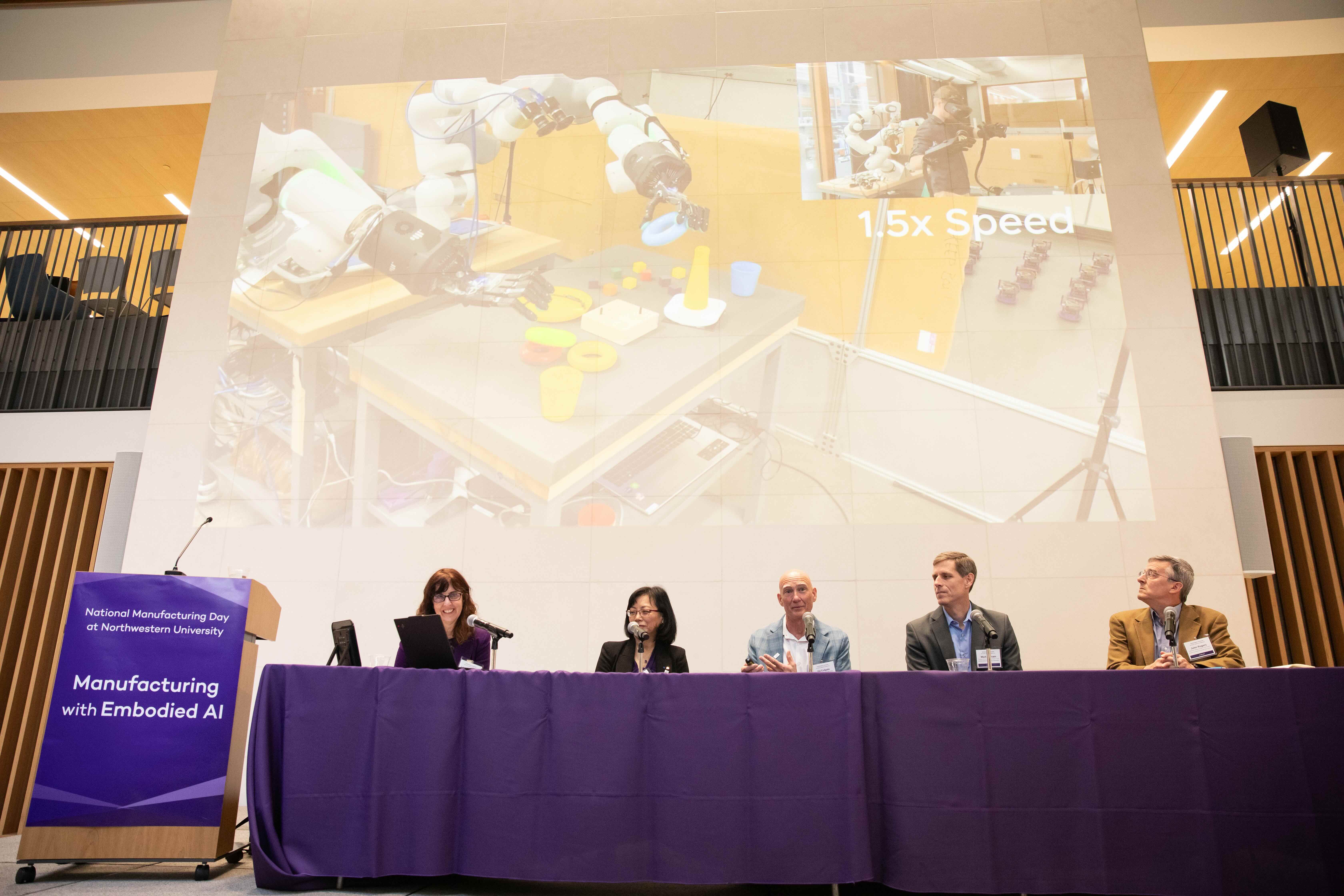
From left: moderator Linda Broadbelt, senior associate dean and professor of chemical and biological engineering; Jian Cao and Ed Colgate, professors of mechanical engineering; Mark Hersam, professor of materials science and engineering; and John Rogers, professor of materials science and engineering, biomedical engineering and neurological surgery, discuss manufacturing and embodied AI during Northwestern’s National Manufacturing Day on Oct. 2. This faculty panel was one of several discussions throughout the daylong event. Photo by Eileen Molony.
National Manufacturing Day highlights research and partnerships to accelerate innovation from the laboratory to the marketplace
EVANSTON, Ill. — Northwestern University brought together academic, industry and government leaders Oct. 2 to explore how embodied artificial intelligence could transform manufacturing, health care and supply chains, and how partnerships can accelerate the path from research to market.
This year’s National Manufacturing Day program, “Manufacturing with Embodied AI,” took place in the former Jacobs Center at 2001 Sheridan Road in Evanston. National Manufacturing Day was established in 2012.
Hosted by the Northwestern Initiative for Manufacturing Science and Innovation (NIMSI), the daylong event featured leadership remarks, panels with researchers and industry leaders, and laboratory tours.
A commitment to industry partnership
Provost Erik Luijten opened the event by praising Northwestern students and faculty for their innovation. He highlighted two recent National Science Foundation Engineering Research Centers: HAMMER (Hybrid Autonomous Manufacturing: Moving from Evolution to Revolution) and HAND (Human AugmentatioN via Dexterity).
President Mung Chiang (pictured at podium) said Northwestern is well positioned to help shape a period in which manufacturing and global supply chains are being “redrawn.”
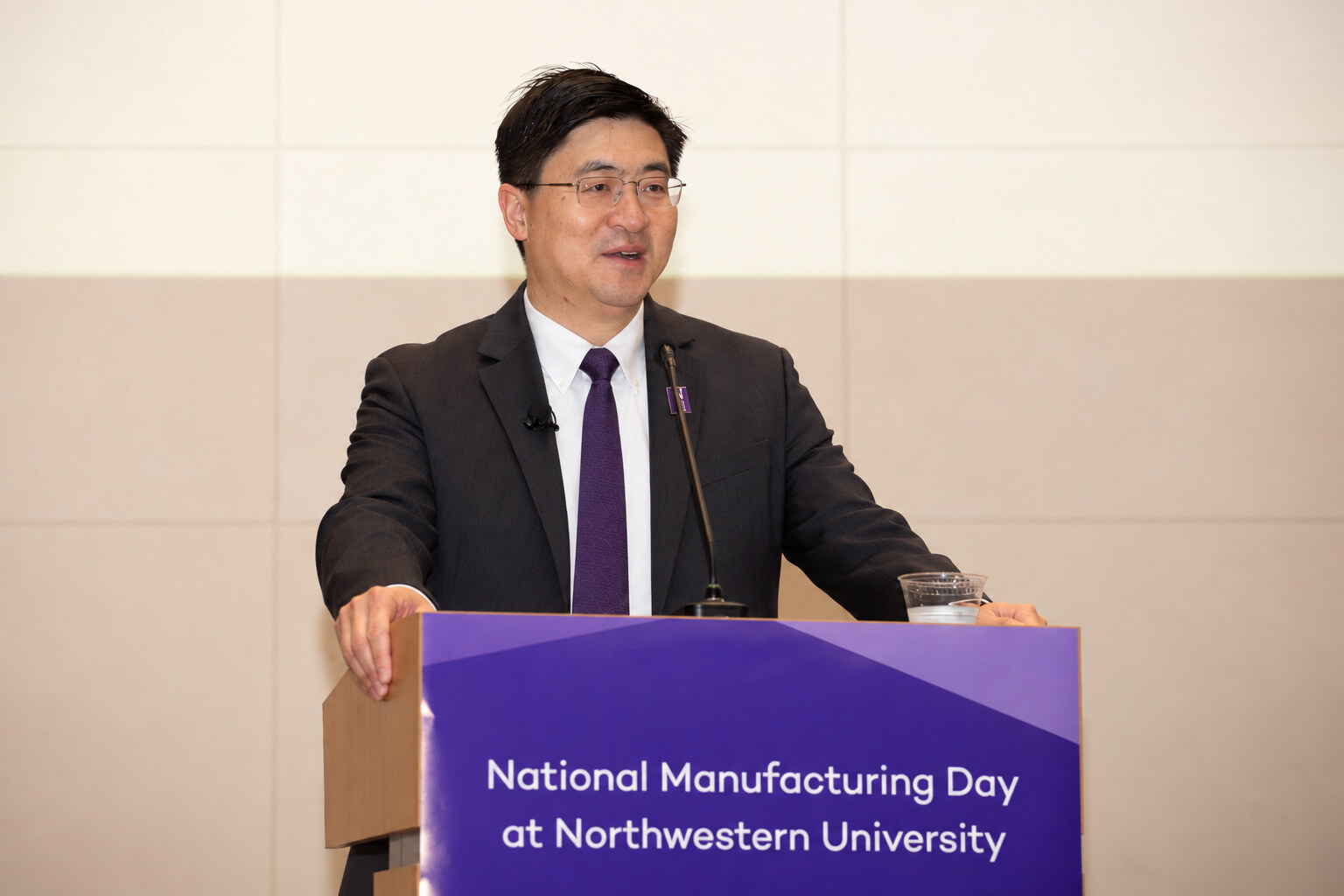
“We are entering one of the most exciting epochs ever in manufacturing,” Chiang said, citing Northwestern’s strengths in process and materials innovation and applications in life sciences, energy and artificial intelligence.
He extolled Northwestern’s core facilities and addressed industry representatives directly: “Northwestern will be the most industry-friendly university in the United States.”
Chiang said Northwestern will move quickly to expand industry engagement, including through the newly launched Office for Industry Partnerships and Economic Development, and help “solve problems that matter to industry” in a rapidly changing competitive environment.
“At Northwestern, you have the most dedicated partner with the best talented faculty,” Chiang said. “Gone are the days of roadblocks and friction.”
Lisa Strama, president and CEO of the National Center for Manufacturing Sciences, emphasized collaboration among universities, industry and government to shorten the seven-to-10-year—or longer—engineering timeline for bringing innovations to market.
“We want to compress that to three to four years,” Strama said.
Connecting AI, research and industry
Embodied AI integrates artificial intelligence with physical systems, including machines, materials and robotics. Panelists explored its potential to accelerate innovation while identifying challenges in connecting virtual models with the physical world.
“Manufacturing is an integration platform, which brings together nearly all disciplines,” said Jian Cao, associate vice president for research, Cardiss Collins Professor of Mechanical Engineering and NIMSI director. “At Northwestern, our manufacturing focuses on three aspects: flexible, personalized and secure manufacturing; integrated computational design, AI and manufacturing; and logistics, policy analysis, and education. Embodied AI gives us new tools to co-design, make and improve things in ways that were not previously possible.”
Cao chaired the corporate panel featuring Stan Rendon, vice president of research and development at 3M; Yu Cao, chief AI officer at Applied Materials; and Amey Deosthali, senior director and head of Robotics, Industrial, Manufacturing and Healthcare for Physical AI at AMD.
Rendon said 3M has approximately 60,000 products, with about one-third refreshed every five years. Sustaining that pace—and continually renewing a 125-year-old company—requires innovation in materials discovery and manufacturing processes.
Asked about AI’s potential impact on 3M over the next 18 months, Rendon said it will help “prepare us for the supply chain of the future” as the company develops new systems alongside existing hardware.

From left: Yu Cao, chief AI officer at Applied Materials; panel moderator Jian Cao, Northwestern associate vice president for research and NIMSI director; Stan Rendon, vice president of R&D at 3M; and Amey Deosthali, AMD senior director and head of robotics, industrial, manufacturing and healthcare (physical AI), at Northwestern’s National Manufacturing Day.
Deosthali highlighted nursing and surgery as areas where embodied AI could have an outsized impact. He said approximately 70 percent of nursing time goes to logistical and administrative activities that robots could potentially handle, freeing nurses for direct patient care. Surgical robots, he said, can be “much, much more precise in their incisions than humans” and could reduce health care costs by approximately 30 percent.
Collaboration also requires protecting intellectual property and data, panelists noted. Yu Cao described Applied Materials’ development of a $4 billion collaboration platform as a “critical tool for technological innovation.”
University partnerships can ease information-sharing barriers encountered in industry-to-industry collaborations, panelists said. Universities also supply “critical fresh talent,” Rendon said, noting that 3M employs specialists beyond engineering, including anthropologists who provide an ethnographic perspective.
All three panelists emphasized internships. Jian Cao noted that providing internships is a goal of Northwestern’s newly established MS in Advanced Manufacturing program.
Linda Broadbelt, senior associate dean of Northwestern Engineering and professor of chemical and biological engineering, moderated a faculty panel featuring Jian Cao, director of the Northwestern Initiative for Manufacturing Science and Innovation; Ed Colgate, director of the HAND Engineering Research Center; Mark Hersam, director of the Materials Research Center; and John Rogers, director of the Querrey Simpson Institute for Bioelectronics and QSI-TEAMS. Their expertise spans manufacturing, robotics, materials science and bioelectronics. Rogers also holds appointments across Northwestern’s engineering, arts and sciences, and medical schools. The panel’s breadth reflected Northwestern Engineering’s emphasis on connecting disciplines and schools to address complex challenges and opportunities, including those facing manufacturing.
"Manufacturing is inherently interdisciplinary," Broadbelt said. "At Northwestern, advances in materials, robotics, artificial intelligence and human-machine interaction come together across schools and facilities, giving our students and faculty the tools to develop technologies that can move from fundamental discovery to practical impact.”
From research to market
A panel of founders and small-to-midsize enterprises, moderated by Curtis Maas, chairman and CEO of The RDI Group, examined commercialization and the skills needed for success. Panelists encouraged students to pair technical depth with interpersonal and business skills.
Jason Sebastian, executive vice president of QuesTek Innovations, recalled that designing materials with computers was “wild stuff” when he was earning his Northwestern materials science PhD about a quarter-century ago. Today, integrated computational materials engineering is established, and QuesTek has expanded into software development.
“Software is a sales game,” Sebastian said. “I thought we would need more coders to achieve our goals. We actually need more sales directors.” AI can sift through “reams of data” at high speed, he added, but must be paired with human understanding.
Demeng Che, co-founder and CEO of Converge Lab and another Northwestern graduate, contrasted software’s faster development and lower upfront costs with hardware’s capital requirements and limited flexibility.
“It’s nearly impossible for you to pivot in a different direction,” Che said. In software, entrepreneurs can “learn on-the-go, talk to customers, figure out their problems and pivot accordingly. But hardware is totally different. If you are not signed up for the long term, and you are not very sure this is going to be the right thing to do, don’t do it.”
Che further advised students to develop “deep-thinking” capability, which becomes increasingly important at this AI-stage. This deep-thinking training was the most valuable experience he received at Northwestern.
Gino Domel, a former Northwestern postdoctoral scholar and co-founder and CEO of HiDeNN-AI, a Northwestern spinout based in the Querrey InQbation Lab, emphasized the transition from technical expert to business leader.
Entrepreneurs must move from being a “technical person to actually running a company, and being the CEO of a company … from building, to actually trying to understand what the end-user, what the customer, actually wants and needs,” Domel said.
Engineers should view AI as a “co-pilot that understands how to help you and work alongside you … an agent working directly with you at all times, and hopefully talking to you directly.” When hiring, he added, “what you’re looking for is someone who is able to augment themselves with AI, not someone that’s almost replaced themselves with AI, so that AI is doing and thinking for them.”
Joe Mullenbach, co-founder and CEO of Fluid Reality and also a Northwestern graduate, encouraged students to draw on their Northwestern peers.
“Take advantage of the highly intelligent, creative, ambitious people that surround you,” Mullenbach said. Entrepreneurship requires playing “this very complex game of having to move fast, and do things that don’t scale, when you’re starting. But you also have to keep your eye on the long-term, and make sure you’re not doing things that cannot scale [down the road] because then you’ll end up getting a roadblock later that you just can’t overcome.”
Strengthening the manufacturing ecosystem
An ecosystem panel moderated by Interim Vice President for Research Sumit Dhar examined how public, private and academic partners can strengthen U.S. manufacturing through technology adoption, workforce development and shared resources.
Tom Kurfess, chief technology officer at the National Center for Manufacturing Sciences and chief manufacturing officer at Georgia Tech, said large multinational companies are moving quickly with AI, but small and midsize manufacturers need help keeping pace.
“Not the next Google or Facebook … but those small enterprises that are powering the U.S. economy and are supporting the middle class,” Kurfess said. “That is important. If we don’t keep that, I think the nation as a whole is in big trouble.”
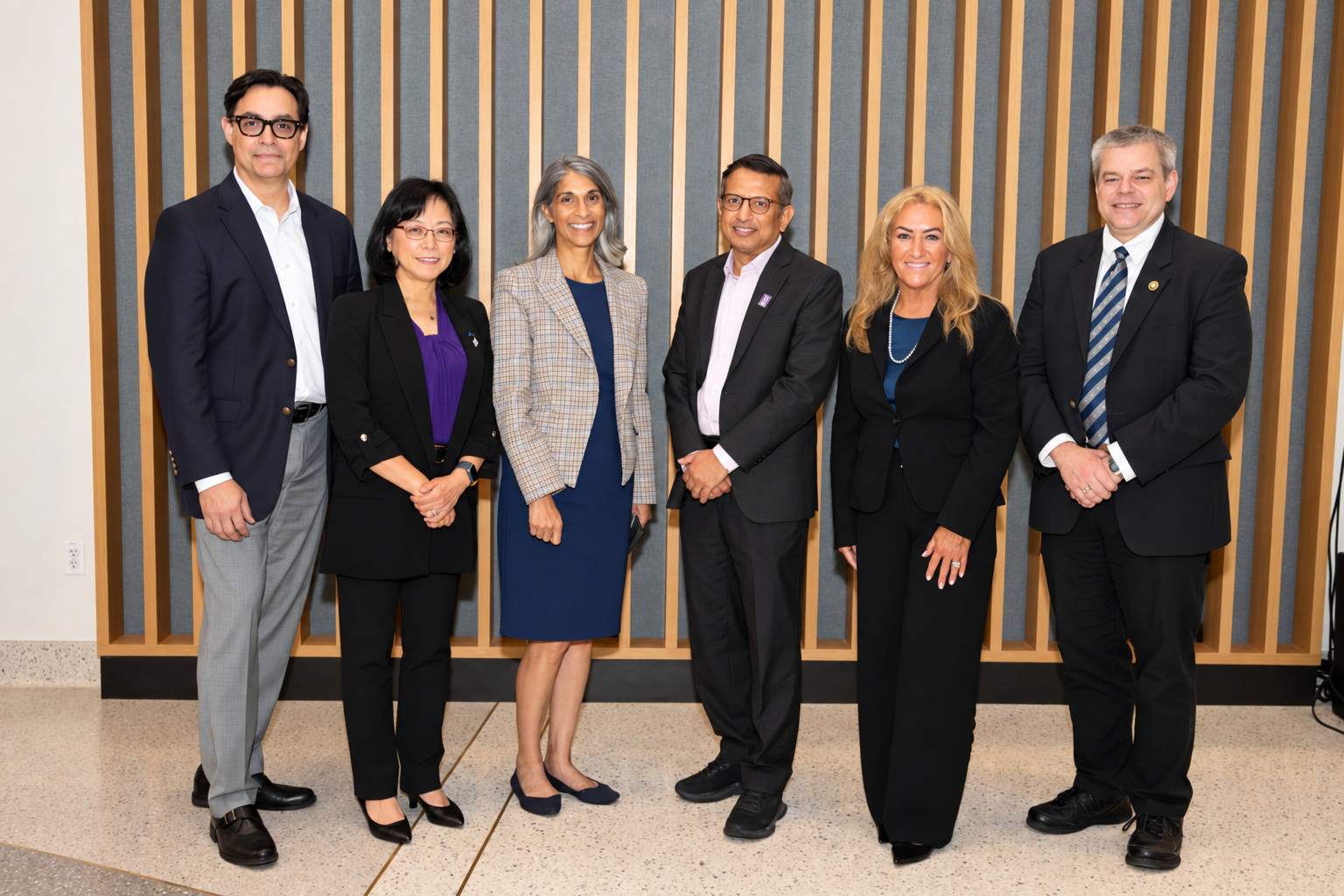
At Northwestern’s National Manufacturing Day, from left: Enectali (“Tali”) Figueroa-Feliciano, associate vice president (AVP) for research overseeing national labs and federal agencies; Jian Cao, AVP for research and director of the Northwestern Initiative for Manufacturing Science and Innovation; Lisa Dhar, AVP for innovation; Sumit Dhar, interim vice president for research; Lisa Strama, president and CEO of the National Center for Manufacturing Sciences; and Tom Kurfess, chief manufacturing officer, Georgia Tech.
Three-quarters of U.S. manufacturing firms have fewer than 20 employees, said Berardino Baratta, CEO of MxD, a digital cybersecurity institute funded by the U.S. Department of Defense. Smaller firms also generate less revenue and pay lower salaries, he noted.
“AI will allow them to shift from 1900s manufacturing to 2100s manufacturing,” Baratta said. AI could help address the expected retirement of about 4 million manufacturing workers, he added, but retaining employees’ practical expertise requires training and support. “You need them there to stay because they know how to do what they do really well,” Baratta said.
Lisa Clemmons Stott, chief business attraction and development officer at the Illinois Department of Commerce and Economic Opportunity, said advanced manufacturing is one of Illinois’ six priority sectors.
“We do not develop our economic toolkit from the top down. We do it from the bottom up,” Clemmons Stott said. “We’re talking to businesses every single day, and we hear from them specifically what they need to succeed.”
She highlighted state investments in community college manufacturing training academies and related K-12 initiatives. “The earlier you catch a kid to let them know that this world is possible, the more chance you have for them to get where they need to go,” Clemmons Stott said. She also cited the State of Illinois’ Advancing Innovative Manufacturing tax credit, which recognizes companies making capital investments in smart manufacturing processes.
Allison Fisher, chief of staff at mHUB, a Chicago-based manufacturing incubator that helps hardtech startups overcome steep upfront costs, long development cycles and supply chain hurdles, emphasized linking AI-enabled design with production. “How do we make sure we lead on the innovation of new products, the deployment of those products, and the production?” Fisher said.
The next generation of hardware infrastructure will require mechanical and electrical engineering alongside software, she added. “Software can only get us so far to optimize those if we don’t have the right devices in market,” she said. “How do we put together the whole mix of skill sets and bring them together?”
The event concluded with open-house tours at the Technology Institute, where participants explored Northwestern laboratories and technologies connected to advanced manufacturing, robotics, materials and embodied AI.
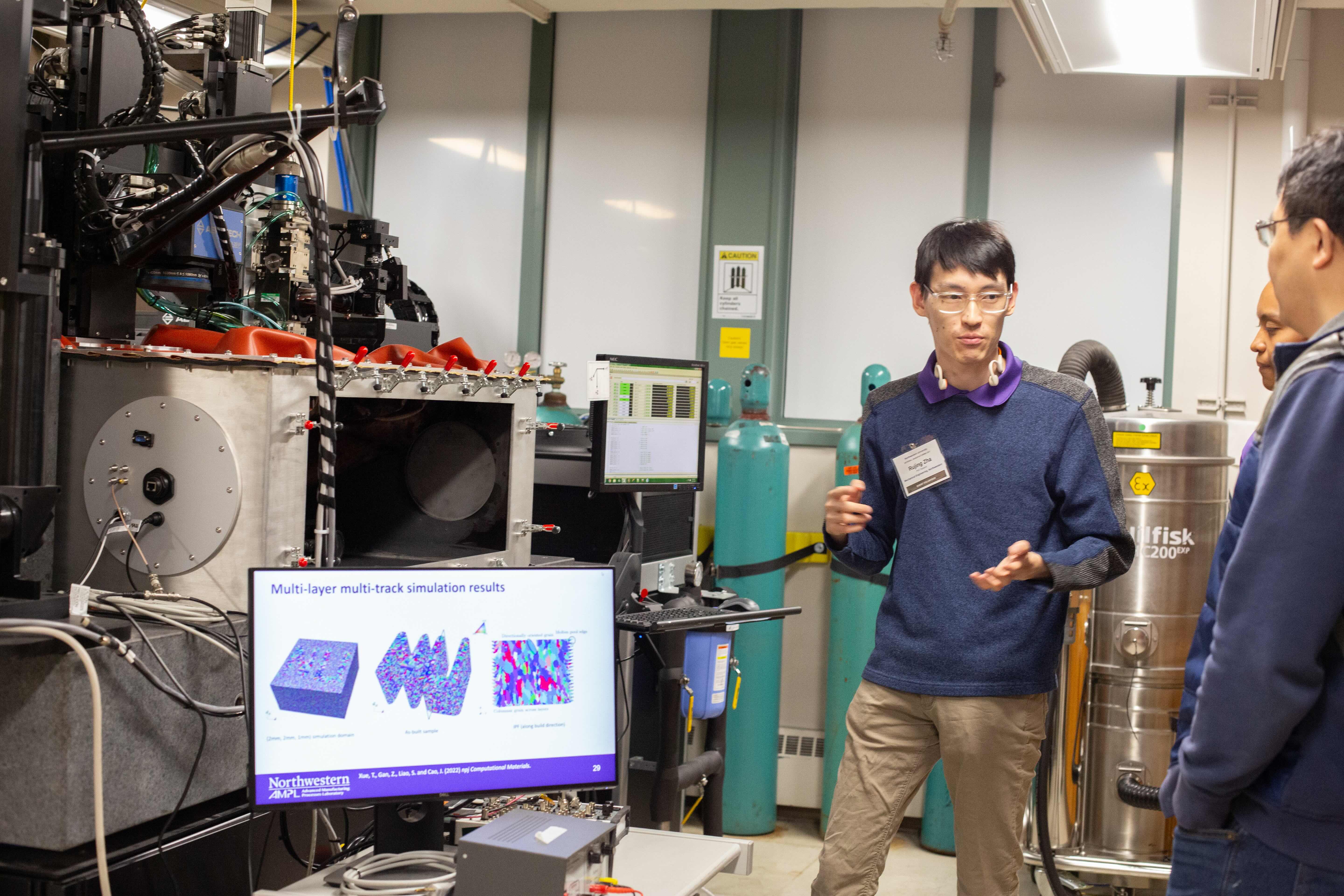
Mechanical engineering PhD student Rujing Zha in the Cao Lab during Northwestern’s Manufacturing Day on Oct. 2. Attendees explored several engineering labs across the Evanston campus, getting a firsthand look at research shaping the future of manufacturing. Photo: Eileen Molony